This page was generated from
docs/Examples/4a. other_fug_coeff.ipynb.
Interactive online version:
 .
.
4a. Calculate fugacity coefficients
This allows you to calculate the fugacity coefficient for all vapor species in the CHOSX system at a given P and T.
It can be run for multiple sets of conditions defined in the input data frame or loaded from a csv file.
Python set-up
You need to install VolFe once on your machine, if you haven’t yet. Then we need to import a few Python packages (including VolFe).
[1]:
# Install VolFe on your machine. Don't remove the # from this line!
# pip install VolFe # Remove the first # in this line if you have not installed VolFe on your machine before.

# import python packages
import pandas as pd
import matplotlib.pyplot as plt
import VolFe as vf
Conditions from dataframe
Define the inputs
This first example is for a single set of conditions defined in a dataframe.
[2]:
# Define conditions T as a dictionary.
my_analysis = {'Sample':'test',
           'T_C': 1200., # Temperature in 'C
           'P_bar':1000.} # Pressure in bar

# Turn the dictionary into a pandas dataframe, setting the index to 0.
my_analysis = pd.DataFrame(my_analysis, index=[0])
We’ll use the default options
[3]:
# print default options in VolFe
print(vf.default_models)
                            option
type
COH_species     yes_H2_CO_CH4_melt
H2S_m                         True
species X                       Ar
Hspeciation                   none
fO2                       Kress91A
...                            ...
error                          0.1
print status                 False
output csv                    True
setup                        False
high precision               False

[78 rows x 1 columns]
Run the calculation
And this runs the calculation
[4]:
vf.calc_fugacity_coefficients(my_analysis)
[4]:
| Sample | P_bar | T_C | yO2 | yH2 | yH2O | yS2 | ySO2 | yH2S | yCO2 | ... | y_H2S opt | y_H2 opt | y_O2 opt | y_S2 opt | y_CO opt | y_CH4 opt | y_H2O opt | y_OCS opt | y_X opt | Date | |
|---|---|---|---|---|---|---|---|---|---|---|---|---|---|---|---|---|---|---|---|---|---|
| 0 | test | 1000.0 | 1200.0 | 1.209858 | 1.126166 | 1.004254 | 1.191327 | 1.206456 | 1.489942 | 1.265765 | ... | Shi92_Hughes24 | Shaw64 | Shi92 | Shi92 | Shi92 | Shi92 | Holland91 | Shi92 | ideal | 2025-02-02 10:12:53.052359 |
1 rows × 26 columns
Conditions from file
Import data
We’ll show an example by loading from the csv file found in files.
[6]:
# Read csv to define melt composition
my_analyses = pd.read_csv("../files/inputs_y.csv")
Run the calculation
And below runs the calculation
[7]:
results = vf.calc_fugacity_coefficients(my_analyses)
Plotting
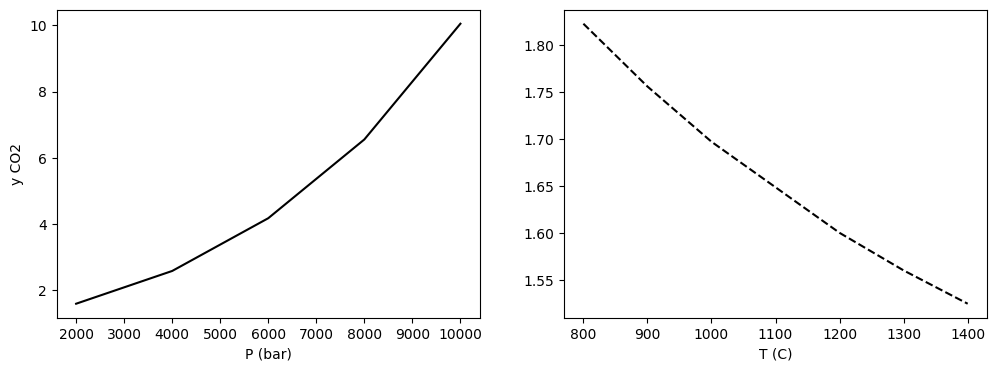
And we can plot them - this is an example for CO2
[8]:
fig, (ax1, ax2) = plt.subplots(1, 2, figsize=(12,4))

data1 = results[results['P_bar'] == 2000.] # 2000 bar
data2 = results[results['T_C'] == 1200.] # 1200 'C

# Plotting results
ax1.plot(data2['P_bar'], data2['yCO2'], '-k')
ax2.plot(data1['T_C'], data1['yCO2'], '--k')

ax1.set_xlabel('P (bar)')
ax2.set_xlabel('T (C)')
ax1.set_ylabel('y CO2')
[8]:
Text(0, 0.5, 'y CO2')