This page was generated from
docs/Examples/2c. degas_open.ipynb.
Interactive online version:
 .
.
2c. Calculate open-system degassing path
During open-system degassing, vapor is lost from the system as soon as it is formed such that the bulk composition of the system changes continuously.
Python set-up
You need to install VolFe once on your machine, if you haven’t yet. Then we need to import a few Python packages (including VolFe).
[1]:
# Install VolFe on your machine. Don't remove the # from this line!
# pip install VolFe # Remove the first # in this line if you have not installed VolFe on your machine before.

# import python packages
import pandas as pd
import matplotlib.pyplot as plt
import VolFe as vf
Check version
[2]:
vf.__version__
[2]:
'0.4.1'
Quick test
The following composition is analysis Sari15-04-33 from Brounce et al. (2014) with the updated Fe3+/FeT from Cottrell et al. (2021), with a temperature chosen as 1200 °C, and lower initial volatile content as a test case.
Because the vapor is being removed at each pressure-step, the pressure step-size does matter. The smaller the step-size, the more true to pure open-system degassing the results will be but the longer it will take. The automatic step size is 1 bar.
The open-system calculations can take a long time because the P-step size is 1 bar, so this example will run quicker than the next one if you just want to see how it looks.
[3]:
# Define the melt composition, fO2 estimate, and T as a dictionary.
my_analysis = {'Sample':'Sari15-04-33',
           'T_C': 1200., # Temperature in 'C
           'SiO2': 47.89, # wt%
           'TiO2': 0.75, # wt%
           'Al2O3': 16.74, # wt%
           'FeOT': 9.43, # wt%
           'MnO': 0.18, # wt%
           'MgO': 5.92, # wt%
           'CaO': 11.58, # wt%
           'Na2O': 2.14, # wt%
           'K2O': 0.63, # wt%
           'P2O5': 0.17, # wt%
           'H2O': 1., # wt%
           'CO2ppm': 50., # ppm
           'STppm': 100., # ppm
           'Fe3FeT': 0.177}

# Turn the dictionary into a pandas dataframe, setting the index to 0.
my_analysis = pd.DataFrame(my_analysis, index=[0])
Running open-system calculations requires changing the “gassing_style” to “open”. We’ll use default options for everything else.
[4]:
# choose the options I want - everything else will use the default options
my_models = [['gassing_style','open']]

# turn to dataframe with correct column headers and indexes
my_models = vf.make_df_and_add_model_defaults(my_models)
[5]:
degas1 = vf.calc_gassing(my_analysis, models=my_models)
99%|█████████▉| 196.0/197 [00:58<00:00, 3.37it/s]
Run the calculation
Open-system - actual example
This one will run slower because the volatile content is higher!
[6]:
# Define the melt composition, fO2 estimate, and T as a dictionary.
my_analysis = {'Sample':'Sari15-04-33',
           'T_C': 1200., # Temperature in 'C
           'SiO2': 47.89, # wt%
           'TiO2': 0.75, # wt%
           'Al2O3': 16.74, # wt%
           'FeOT': 9.43, # wt%
           'MnO': 0.18, # wt%
           'MgO': 5.92, # wt%
           'CaO': 11.58, # wt%
           'Na2O': 2.14, # wt%
           'K2O': 0.63, # wt%
           'P2O5': 0.17, # wt%
           'H2O': 4.17, # wt%
           'CO2ppm': 1487., # ppm
           'STppm': 1343.5, # ppm
           'Fe3FeT': 0.177}

# Turn the dictionary into a pandas dataframe, setting the index to 0.
my_analysis = pd.DataFrame(my_analysis, index=[0])
[7]:
degas2 = vf.calc_gassing(my_analysis, models=my_models)
62%|██████▏ | 2406.0/3862 [20:56<12:40, 1.91it/s]
Comparison to closed-system
We can also run the closed-system calculations for comparison…
[8]:
# closed-system degassing calculation
degas3 = vf.calc_gassing(my_analysis)
100%|█████████▉| 3799.0/3800 [00:25<00:00, 147.04it/s]
Plotting
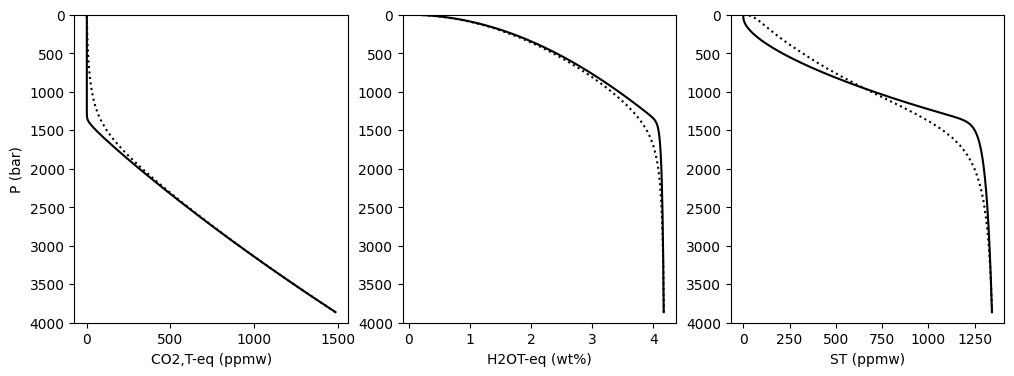
… and plot them: open-system degassing is the solid black curve, whereas closed-system degassing is the dotted black curve.
[9]:
fig, (ax1, ax2, ax3) = plt.subplots(1, 3, figsize=(12,4))

data1 = degas2 # open-system
data2 = degas3 # closed-system

# Plotting results
ax1.plot(data1['CO2T-eq_ppmw'], data1['P_bar'], '-k')
ax1.plot(data2['CO2T-eq_ppmw'], data2['P_bar'], ':k')
ax2.plot(data1['H2OT-eq_wtpc'], data1['P_bar'], '-k')
ax2.plot(data2['H2OT-eq_wtpc'], data2['P_bar'], ':k')
ax3.plot(data1['ST_ppmw'], data1['P_bar'], '-k')
ax3.plot(data2['ST_ppmw'], data2['P_bar'], ':k')

ax1.set_ylabel('P (bar)')
ax1.set_xlabel('CO2,T-eq (ppmw)')
ax2.set_xlabel('H2OT-eq (wt%)')
ax3.set_xlabel('ST (ppmw)')
ax1.set_ylim([4000,0])
ax2.set_ylim([4000,0])
ax3.set_ylim([4000,0])
[9]:
(4000.0, 0.0)